



Fast Self-Service for Facebook Users.
24/7 online service available to all customers.
To avoid waiting time online, you could submit a ticket to us, our agent will respond within 1 business day.


Fast Self-Service for Facebook Users.
24/7 online service available to all customers.
To avoid waiting time online, you could submit a ticket to us, our agent will respond within 1 business day.
Sign In / Register
My Balance
Modlily Club
Sign in for the best experience
Processing
Please enter a valid number
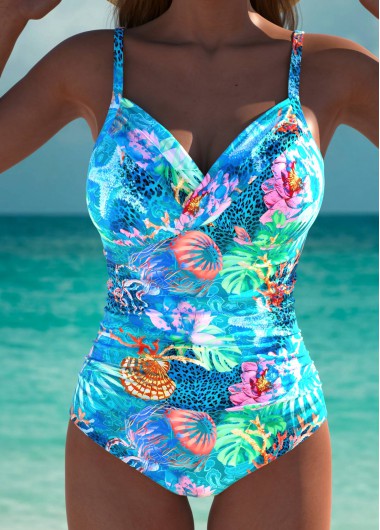

Very cute
 MODLILY CLUB
% Off
MODLILY CLUB
% Off
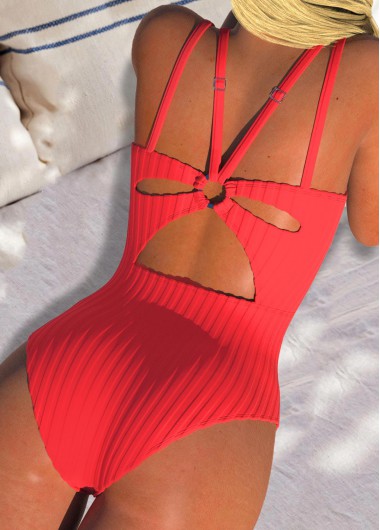
Very cute love the color and fit
MODLILY CLUB
% Off
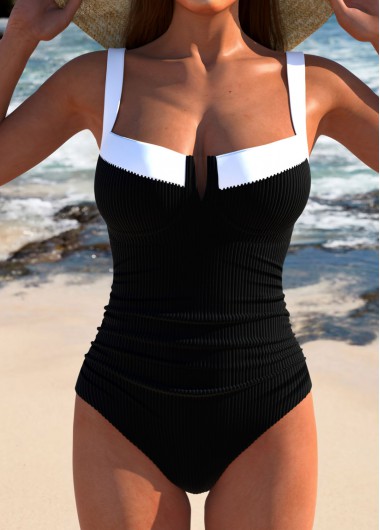
Beautiful fit and excellent after care..
MODLILY CLUB
% Off
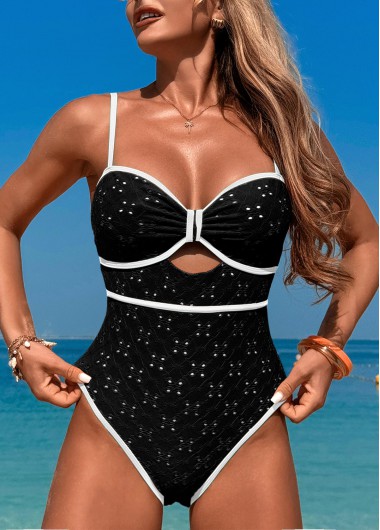 MODLILY CLUB
% Off
MODLILY CLUB
% Off
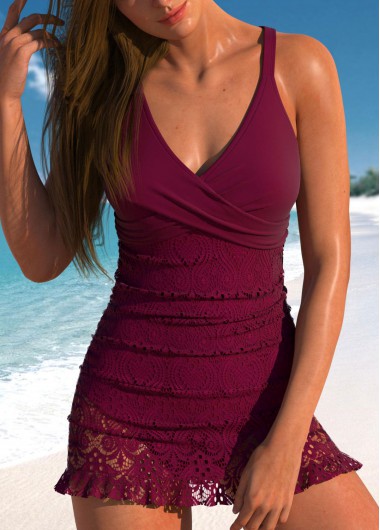
My favorite place to buy a swimsuit… fits well…
MODLILY CLUB
% Off
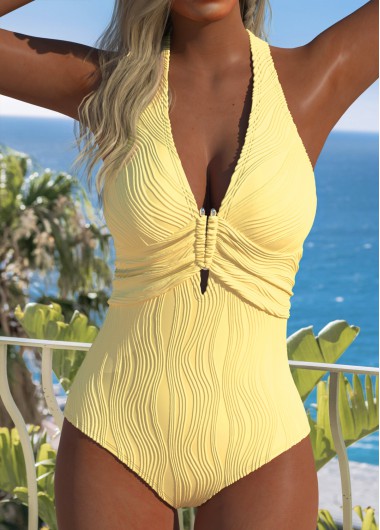 MODLILY CLUB
% Off
MODLILY CLUB
% Off
 MODLILY CLUB
% Off
MODLILY CLUB
% Off
 MODLILY CLUB
% Off
MODLILY CLUB
% Off
 MODLILY CLUB
% Off
MODLILY CLUB
% Off
 MODLILY CLUB
% Off
MODLILY CLUB
% Off
 MODLILY CLUB
% Off
MODLILY CLUB
% Off
 MODLILY CLUB
% Off
MODLILY CLUB
% Off
 MODLILY CLUB
% Off
MODLILY CLUB
% Off

Cut out one piece swimsuits go by two names, which is worth knowing before comparing listings. Monokini came first and described a one-piece with a section removed; cutout is the plainer description that has largely replaced it. A third word, trikini, turns up on the same rack.
Neither name tells you anything useful about where the opening is, and that is the only thing that matters. Two suits both sold as monokinis can look unrelated — one open at the waist, one across the back — so read the photograph rather than the name.
Three placements cover almost everything in this category, and they suit different concerns.
Side waist. The most common. Openings at the narrowest part of the torso, usually mirrored on both sides. They emphasize the waist by framing it, and because the panel between them stays intact, the front coverage is unchanged. This is the version to look at if you want the effect without exposing the stomach.
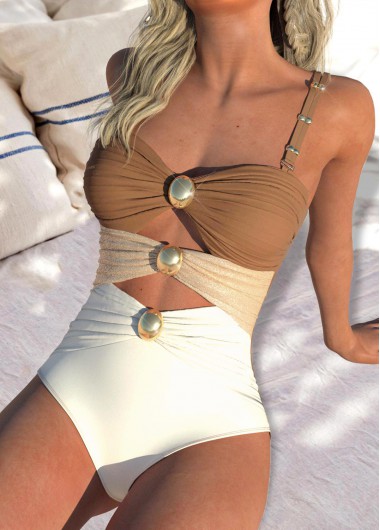
Front. An opening below the bust or at the center of the torso. More dramatic, and the one that changes coverage most — check how the remaining panel is anchored, since a front cutout takes fabric from the part of the suit doing the shaping. A listing for a one piece cutout swimsuit will call this a front cutout or a center opening; both describe the same thing.
Back. Openings behind rather than in front, keeping the whole front intact. The least demanding way to wear the style, and it overlaps with the open back range where the back is the whole design rather than a detail.
A few designs let you set the size of the opening yourself, through a ring, a tie or a lacing at the side that draws the two edges together. The gain is tolerance: a fixed opening has one correct torso length, while an adjustable one absorbs an inch either way. Ties loosen in water, so check that a strap or the suit's own tension holds them.
Placement decides this, not body type. An opening draws the eye to whatever sits beside it, so the useful question is where you want that attention.
From there the mapping is simple. A side-waist opening pulls the eye to the narrowest part of the torso and reads as a waist. A front opening below the bust does the same job higher up. A back opening changes the front view not at all, which is why it works on the widest range of people, and why sexy one piece swimsuits so often pair an open back with something restrained in front.
Two openings mirrored across the body read calmer than one placed off to a side, and a run of small openings reads busier than a single large one of the same total area. An opening low on the hip belongs to the leg line instead of the torso, which puts it closer to a cheeky one piece decision than a cutout one. A high neck one piece with an open back takes the same split to its limit.
Fabric removed is water let in, and the difference shows up within a few strokes.
An opening at the side waist sits above the waterline for most of a swim and behaves like a plain suit. One under the bust catches water on every push forward, which tugs the panel above it downward — the reason a front-opening one piece cut out swimsuit is worth a trial length before a long day of actual swimming. An opening across the back fills and empties as you roll.
The edge finish decides most of the rest. A bound or elasticated edge holds its line wet; a softer rolled edge flutes slightly once it is saturated. Color hides or reveals all of it — a black one piece gives almost nothing away at the opening, while a pale one shows every seam.
It gets asked often enough to answer properly: not really, and the reason is structural rather than a matter of sewing skill.
Swim fabric is knitted, so a cut edge curls and runs along the loops instead of lying flat. More to the point, the edges of a swimsuit are not simply closed — each carries elastic set into it that holds the tension of that whole section. Cut through one and the pull it was carrying transfers to the fabric beside it, which then distorts.
What can be altered is the seams rather than the surface: shortening a strap, taking in a side seam. Both work inside the structure instead of removing part of it. If an opening is what you want, a cutout one piece swimsuit drafted with one costs less than the two attempts it usually takes otherwise.
The part that gets overlooked. Fabric removed from the torso is fabric no longer holding the top of the suit down, so a cutout style relies more on the bust construction than a plain one does. Check for a molded cup or a proper band rather than a shelf lining — underwire one piece swimsuits are the version that holds. The rest of the range is in one piece swimwear.

Create Account
Create password to get more coupons!
$100 OFF
New Members only!
Create Account
Create password to get more coupons!
$100 OFF
New Members only!
$20 OFF
for text subscribe

*It includes 4 coupons
Expired:
CODE:
Expired:
Fast Self-Service for Facebook Users.
24/7 online service available to all customers.
To avoid waiting time online, you could submit a ticket to us, our agent will respond within 1 business day.