



Fast Self-Service for Facebook Users.
24/7 online service available to all customers.
To avoid waiting time online, you could submit a ticket to us, our agent will respond within 1 business day.


Fast Self-Service for Facebook Users.
24/7 online service available to all customers.
To avoid waiting time online, you could submit a ticket to us, our agent will respond within 1 business day.
Sign In / Register
My Balance
Modlily Club
Sign in for the best experience
Processing
Please enter a valid number
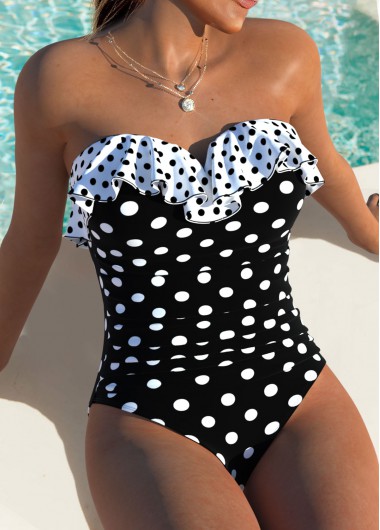

Absolutely gorgeous and perfect fit.
 MODLILY CLUB
% Off
MODLILY CLUB
% Off
 MODLILY CLUB
% Off
MODLILY CLUB
% Off
 MODLILY CLUB
% Off
MODLILY CLUB
% Off

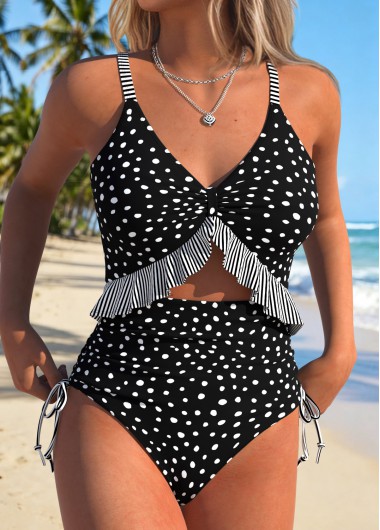
Two polka dot one piece swimsuits in the same colors can look nothing alike, and the variable almost nobody checks is the scale of the print. It is visible in every product photograph once you know to look.
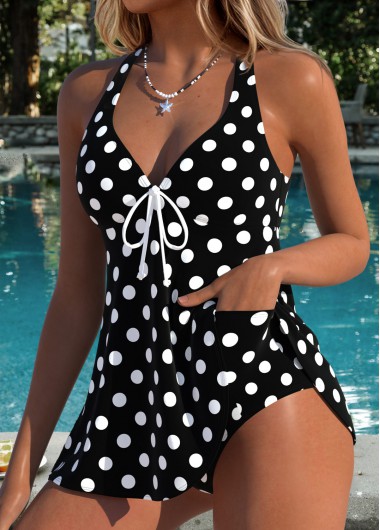
Small and dense. Dots a few millimetres across, packed close together, blur into a single tone from a few steps away. The suit reads as a textured solid rather than a pattern, which makes it the easiest version to wear and the one that dates slowest.
Medium. Clearly a polka dot at conversational distance but still a background rather than a statement. The most common scale, and the safest choice if you are unsure.
Large and spaced. Dots the size of a coin or bigger, with room between them. This reads as deliberate and retro, and it behaves like a graphic — which means placement matters. A large dot repeat across the widest part of the body draws attention there, in a way a small one never does.
Spacing does as much work as size. The same dot with twice the gap between repeats reads twice as strong, because what the eye picks up is the contrast between dot and background rather than the dot itself.
Classic black and white is the reference point and behaves like a neutral — it goes with any cover-up and never looks of a particular year. See the black and white range for the full version of that.
Brown and cream sits softer and warmer, and it is the combination that has moved furthest into current styling — closer to a tonal print than to a contrast one. Red with white reads distinctly retro, particularly at a larger dot scale, and pairs naturally with the retro range. Navy with white is the quietest of the four and the closest to a plain blue suit in how it wears.
Print scale and color interact as well, which is worth holding in mind when comparing two listings. A large dot in a high-contrast pairing is about as loud as swimwear gets; the same large dot in brown on cream is quiet enough to read as a plain suit from across a pool.
One thing to check on any light-background version: a pale ground behaves like a pale solid and needs a full lining to stay opaque when wet. That is a construction detail rather than a print one, and it is worth confirming in the description before ordering.
Polka dot is the only common swimwear print laid out on a regular grid, and that brings two problems no other pattern has.
Seams are the first. Whether the pattern lines up across a side seam is visible immediately — half a dot out of register and the eye catches it, where the same misalignment in a floral would never be noticed. Look at the seam in the product photograph rather than at the front.
Curves are the second. A print is drawn flat then wrapped around a body, so the dots stretch wider across the bust and stomach. Some of that is unavoidable — but the better the cut, the more evenly it distributes. A one piece covers the whole torso in one expanse of fabric, so both effects show more than on a two-piece, which makes polka dot one piece swimsuits an honest test of how well they were drafted.
The one-piece shape leaves the neckline as the main variable, and it changes the whole look more than the dots do. A strapless or bandeau cut lets the print run uninterrupted across the body, which suits a large dot scale. A halter breaks the pattern diagonally and narrows the shoulder line. A high neck keeps the print away from the face entirely, which works better with a busy small repeat — see high neck styles. For the same print in two-piece and tankini cuts, the wider polka dot range carries it across every shape.

Create Account
Create password to get more coupons!
$100 OFF
New Members only!
Create Account
Create password to get more coupons!
$100 OFF
New Members only!
$20 OFF
for text subscribe

*It includes 4 coupons
Expired:
CODE:
Expired:
Fast Self-Service for Facebook Users.
24/7 online service available to all customers.
To avoid waiting time online, you could submit a ticket to us, our agent will respond within 1 business day.