



Fast Self-Service for Facebook Users.
24/7 online service available to all customers.
To avoid waiting time online, you could submit a ticket to us, our agent will respond within 1 business day.


Fast Self-Service for Facebook Users.
24/7 online service available to all customers.
To avoid waiting time online, you could submit a ticket to us, our agent will respond within 1 business day.
Sign In / Register
My Balance
Modlily Club
Sign in for the best experience
Processing
Please enter a valid number

Excellent fit
 MODLILY CLUB
% Off
MODLILY CLUB
% Off

Low rise describes height, and height is only one of the measurements that decide how much a bottom covers. The waistband sits below the navel, usually across the top of the hip bones, but the depth of the front panel beneath it varies a great deal. Two low rise bikini bottoms with the same waistband can look entirely different from the front.
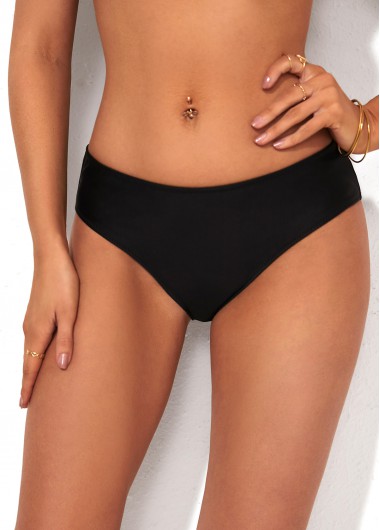
The detail that matters is the distance from the waistband to the crotch seam. A generous front keeps a wide, smooth panel over the lower stomach and reads as moderate coverage; a short front drops to a narrow V and reads as minimal. A straight-on product photograph shows this better than any description.
The shape of the band helps too. A band that runs straight across covers more than one that dips into a V at the center, and a wider band lies flatter than a narrow one. For the most coverage below a low waist, look for both, over a back that covers the seat.
If the lower stomach is the priority, a mid rise lifts the band a little and changes coverage more than any other single adjustment. High waisted and mid rise bottoms show that step, and full coverage swimwear bottoms show the fullest seat.
For a low rise, go by the hip measurement and treat the waist as secondary. The band rests on the hip bones, so the hip figure on the size chart describes where the fabric actually sits. A size chosen by waist alone is the most common reason a low bottom feels wrong.
Between two sizes, the right choice depends on what goes wrong. Too small, and the band presses into the soft area just above the hip bone and rolls over itself when you sit. Too large, and the band has nothing to grip below it, so it slips lower each time you step out of the water. Where a hip figure falls near the top of a size range, the larger size is usually the safer one, because a low band has no waist above it to stop it slipping.
A sitting test settles it. Sit on the edge of a chair and lean forward: a band that stays flat and level there will hold in the water, while one that folds or gaps at the back needs another size. Swim fabric relaxes when wet, so a band that is barely secure dry will feel loose after a swim.
General fit notes for every rise are on the bikini bottoms page, and booty short bikinis look at which bottom flatters most.
Low rise bottoms come in two constructions. A tie side replaces the side panel with strings, so the band is set on the body. A fixed band is a continuous elastic pulled on over the hips, which fits one size and keeps that setting.
Ties suit anyone whose hips fall between sizes, because the knot takes up the difference, and they sit a little lighter at the hip. Over a day of swimming, though, any knot slowly works loose; how to tie one that holds is covered on the side tie bikini bottoms page.
A fixed band asks for an accurate size and rewards it with a smoother line and no knots at the hip. It suits active days in waves, and it wears more evenly, since no single string takes the strain at one point. Check the side width in the photographs: wider sides spread pressure and keep the band from cutting in.
Either construction pairs easily with a matching top, and low waisted bikinis put the same band under a top chosen to balance it.

Create Account
Create password to get more coupons!
$100 OFF
New Members only!
Create Account
Create password to get more coupons!
$100 OFF
New Members only!
$20 OFF
for text subscribe

*It includes 4 coupons
Expired:
CODE:
Expired:
Fast Self-Service for Facebook Users.
24/7 online service available to all customers.
To avoid waiting time online, you could submit a ticket to us, our agent will respond within 1 business day.