



Fast Self-Service for Facebook Users.
24/7 online service available to all customers.
To avoid waiting time online, you could submit a ticket to us, our agent will respond within 1 business day.


Fast Self-Service for Facebook Users.
24/7 online service available to all customers.
To avoid waiting time online, you could submit a ticket to us, our agent will respond within 1 business day.
Sign In / Register
My Balance
Modlily Club
Sign in for the best experience
Processing
Please enter a valid number

Like this I can use this with other tops
 MODLILY CLUB
% Off
MODLILY CLUB
% Off

Scrunch, ruched and gathered all describe the same technique: fabric sewn along a line of elastic or a drawn seam so that it bunches into soft, even folds. Scrunch is the name used most for the version at the back seam, where the gathers shape the seat. Ruched is the broader term and covers gathers anywhere.
A few other names turn up on listings. Scrunch butt and booty scrunch refer to the back version; shirred usually means rows of thin elastic stitched across a panel, giving a tighter, crinkled texture; and an adjustable ruched side lets the wearer pull the gathers tighter to raise the leg.
What they share is a panel cut longer than the space it covers. The extra length forms the folds, and it is also why a ruched bottom feels softer against the skin than a flat one. It leaves a little give in the panel too, so the bottom moves with the body when you sit or bend.
Where the gathers sit decides what they do.
Side ruching is the most adjustable and the easiest first choice. Back ruching changes the look of the seat most. Front ruching is the placement people mean when they ask about the tummy, and it appears most on high waisted bottoms.
Searches for the best bikini for a chubby tummy, or for ways to hide a belly pooch, lead to ruching more than to any other detail, and the reason is visual. A flat panel of stretch fabric follows every contour beneath it and catches light evenly, so any curve shows as a clear shadow line.
Gathers break that surface up. Each fold casts its own small shadow, and the eye reads the pattern of folds before the outline underneath. It is the effect a busy print creates, achieved with texture in place of color, which is why a ruched front in a solid shade can look as forgiving as a patterned one.
Direction matters. Gathers running diagonally or across the front disguise best, since they cross the line of the stomach; a single vertical seam of gathers lengthens the look without covering much. The higher the rise, the more of the lower stomach the folds reach.
Gathers disguise; they do not compress. A ruched bottom holds the stomach in only when a firm lined panel sits behind the folds, and the description is where to confirm it. For which bottom shape flatters most overall, booty short bikinis go through the options.
It can be done, and it is one of the few swimwear alterations that works at home. The usual method is to sew a length of swim elastic, stretched, along the inside of a seam — the back center seam for a scrunch, the side seams for adjustable ruching — so it pulls the fabric into folds as it relaxes.
Three things decide whether it holds. The elastic must be made for swimwear, since ordinary elastic breaks down in chlorine. The stitch must stretch, so a zigzag in place of a straight line. And the panel needs spare length, so the method works better on a slightly generous bottom than on a close fit.
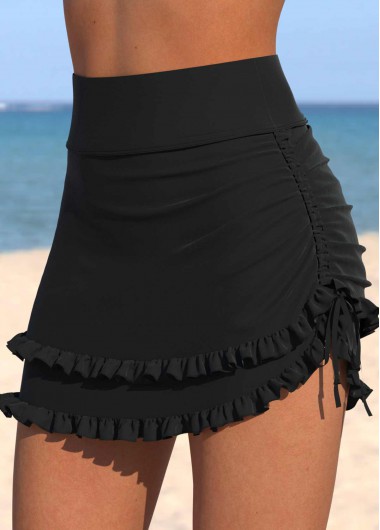
Sewing patterns for ruched bottoms add that length at the cutting stage, which gives more even folds. For a similar softened line without sewing, a swim skirt with a gathered hem does much the same job, and full coverage swimwear bottoms add fabric at the seat.

Create Account
Create password to get more coupons!
$100 OFF
New Members only!
Create Account
Create password to get more coupons!
$100 OFF
New Members only!
$20 OFF
for text subscribe

*It includes 4 coupons
Expired:
CODE:
Expired:
Fast Self-Service for Facebook Users.
24/7 online service available to all customers.
To avoid waiting time online, you could submit a ticket to us, our agent will respond within 1 business day.